Social Structure and Affluence
Sao Paulo is South America's highest GDP city and the tenth largest in the world. Sao Paulo is the financial capital of South America with the headquarters of major companies, banks, and financial institutions.
Sao Paulo has people from all five social classes:
- First class is composed by wealthy bankers, business owners, major landowners.
- Second class is composed by politicians, professors, doctors, and lawyers.
- Third class is composed by those giving services directly to the first and second classes, like teachers, mechanics, and nurses.
- Fourth class is composed by those catering to the third class, such as housemaids, bartenders, bricklayers, and low-paid drivers.
- Fifth class is composed by people who earn minimum salaries, such as cleaners, street sweepers, and also by unemployed people.
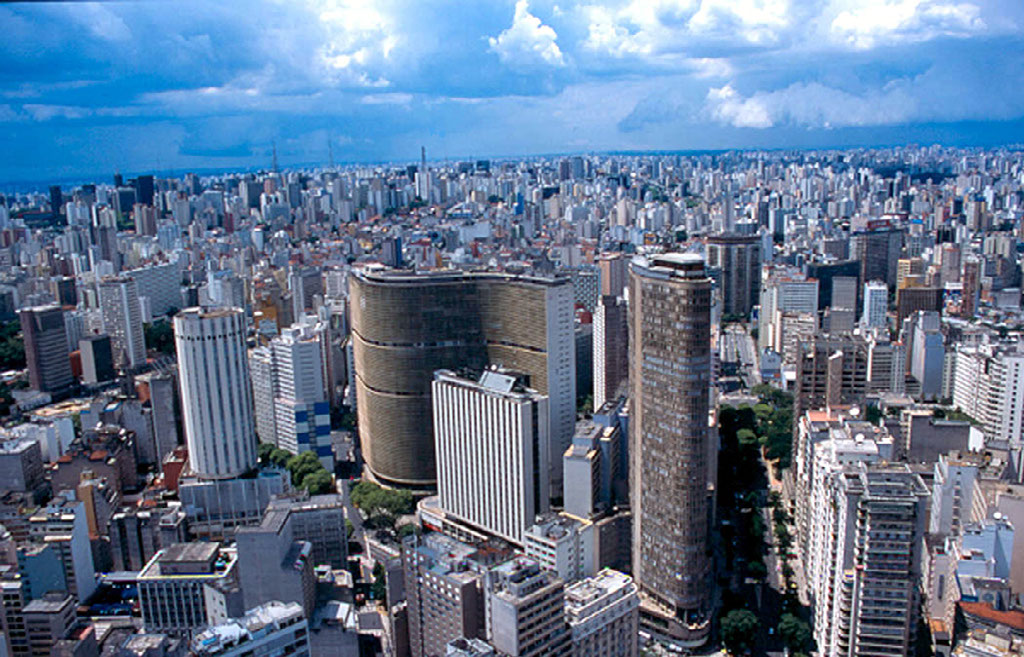
Sometimes this inequality can be observed in the same neighborhood, where an upscale building is located right next to a slum.

Building Structure and Housing
Sao Paulo was originally a very condensed city, with packed-in buildings. As urban growth increased, low-density housing developments sprung up in addition to high-rises. Increases in land prices and regulation caused the rise of very high-density favela and cortico slums, which are low-cost, high-occupancy tenements known for crime and low quality of life.

Waste Management
Toxic industrial wastes and wastewater dumped polluted the local rivers. Sewerage mains represent 89% of the streets but sewage treatment is restricted to 58%. This poses serious water and watershed pollution problem, as 42% of served water goes untreated to the rivers, causing scarcity of clean water near the city. Sao Paulo has 15000 tons of garbage daily, by trucks. With the introduction of a residue tax, in 2004, the volume decreased to 9,678 tons per day. It also has created 31 triage centers that employ 300 persons. 99.5% of the streets are served by the public garbage collection system. In the slum areas, the collection is done in the main streets. Sao Paulo has developed innovative ways for managing very significant amounts of waste, and this implies reducing disposal in the ground, making selective collection with the inclusion of waste pickers, encouraging recycling, and holding citizens co-responsible through educational campaigns in the media.
Energy Sourcing
Brazil gets an overwhelming share of its electricity from renewable sources, primarily hydroelectric power. Roughly 77% of Brazil's power comes from hydroelectric dams, with only 17% coming from fossil fuels. We think it's safe to assume that the energy sourcing of Sao Paulo is reflective of this.

Water
The Tietê River and its tributary, the Pinheiros River, were important sources of freshwater and leisure for Sao Paulo until they got severely polluted. Sao Paulo has efficient water collection, treatment and distribution. 99.4% of households have water connections and 98.5% of its inhabitants have access to potable treated water. Many clean-up programs for both rivers are being carried out, subsidized through a partnership between local government and international development banks, such as the Japan Bank for International Cooperation.
Pollution
The primary form of pollution in Sao Paulo is air pollution from automobiles and industrialization. Restrictions have recently been emplaced to restrict automobile usage in efforts to reduce air pollution. Air pollution seems to be decreasing, and pollution related deaths are going down.
Population Pyramid

Population Momentum
Brazil as a whole has population momentum, which means that national growth would continue even if fertility rates dropped below 2.1 children per woman, which is the replacement rate. Sao Paulo has declining death rates, due to lower homicides and pollution, and a high birth rate as it is. The Sao Paulo megacity has approximately 10% of the whole nation’s population. Sao Paulo’s population is growing at a high rate, so it has solid population momentum.
Demographic Transition Stage
Population of Sao Paulo grew mainly after the end of the 19th Century, reaching 10 millions in 2000 from 31000 in 1872. Birth rate has decreased slowly. Fertility rate is now 1.9 births per woman. Death rate has decreased also due to the improvement in sanitary, economic and nutritional conditions. It is now 6.38 deaths per 1,000 people. Life expectancy is 71.6 years, but it is lower for men, 66.5 years, than for women 75.5 years, due to higher risks among male population, such as violence, tobacco, alcohol consumption, and stress. Population growth rate has decreased a lot. It is now 0.88% per year. Urban population represents 97.7% of the total population in Sao Paulo. Migration rate, which was high before, is negative now. Population density is relatively high, 7024 people per square kilometer.

Until the 1940, Sao Paulo was a condensed city in which different social groups lived in a small urban area distinguished by housing. From 1940 to 1980, Sao Paulo made the upper and middle classes lived in central and modern areas while the lower classes lived in ghetto housing in the nearby region, called favelas. From 1980, the social classes have come closer together but separated by walls and security methods that isolate the upper classes for security. By 1993, 19.8 percent of Sao Paulo’s population lived in favelas, compared to 5.2 percent in 1980. After new transformation, today, 2.1 million or 11 percent of the population live in favelas.
IPAT Equation for Sao Paulo
I (Environmental Impact) = Population X Affluence (GDP per capita) X Technology (different measures)
For Sao Paulo, IPAT would be I = 12.04 million people X USD11,912.13 X Technology (Data unavailable)
Gross Domestic Product
According to data of Fecomercio/SP, its gross domestic product (GDP) in 2011 was R$450 billion, which makes Sao Paulo the tenth richest city in the world.
Sustainable Development
Sao Paulo has prioritized curbing car culture and vehicle greenhouse gas emissions and making the streets of the city more friendly to pedestrians. New zoning rules are allowing for much more development along corridors of transportation in Sao Paulo. Sao Paulo wants to strive to be more sustainable in order to improve quality of life for its citizens and contribute less to worldwide environmental degradation. The city is working towards constructing new sustainable buildings and embarking on many new projects to boost the ecological consciousness of the city’s urban planning.

What is working and what is not for this megacity and what sustainability plans are in place for improving the city?
Sao Paulo was polluted metropolis, but since late 20th century, the city has developed many programs that have been carried out to improve pollution and environmental degradation. One of the programs was the creation of green areas. For four years, the city has obtained over 2.8 million square meters of public green areas, made of parks, squares, and urban agriculture areas integrated into the city landscape. But, the city has only 4.25 kilometer square of public green space per person.

Another program is urban tree planting, whereby roughly 87000 trees were planted in the city in four years. The city has created the municipal Environmental Quality Program that targets a close analysis of water use in parks together with the state water company, leading to more water conservation and savings of $189000 annually. Also it has created the Capivari-Monos Environmental Protection Area, located in the south area and making up one-sixth of the city area with 20000 hectares. It includes remnants of the Atlantic rain forest flora and fauna and three Guarani Native American reserves. It also includes part of the Guarapiranga and Billings water basins and the entire Capivari-Monos basin, making it a vital source of clean water.
The city is trying a sustainable waste management, by putting in place a Master Plan for Solid Waste, which, for example, with the introduction of a residue, decreased the waste to 9,678 tons/day. Land use in the city is regulated by a Master Plan, whose main objective is to decrease the inequalities, reverse the process of suburbanization, and improve environmental conditions in unoccupied downtown areas.
Our thoughts on the future of this MegaCity.
Sao Paulo seems to be on the right track, experiencing high level economic growth, with the environmentally-friendly service, financial, and high tech industries booming. Although the living conditions of the cities poor are not great, with the corticos and favelas, things will doubtlessly improve as the city becomes wealthier and sustainable initiatives help to distribute the wealth of the city’s inhabitants. Sao Paulo is by far the richest city in Brazil, and with so many resources, and a firm foundation with renewable energy, we believe that Sao Paulo is well on its way to becoming a massively sustainable megacity.

Sources
https://en.wikipedia.org/wiki/Environmental_issues_in_Brazil
http://thecityfix.com/blog/sao-paulo-brazil-master-plan-prioritizes-sustainable-urban-development-people-oriented-mobility-public-participation-maria-fernanda-cavalcanti/
https://en.wikipedia.org/wiki/Economy_of_S%C3%A3o_Paulo
https://en.wikipedia.org/wiki/S%C3%A3o_Paulo
http://www.wsj.com/articles/SB10001424052702303404704577311654122552604