The Tutorial Process By julissa cabral
What are Tutorials?

Tutorials are a time for students to collaborate and help one another with questions they are having in academic classes. One problem is picked and groups are separated by subject. Tutors are also there to include help that other students might not be able to supply.
How Often Do Tutorials Occur?

Tutorials are on Tuesdays and Thursdays in the sophomore AVID class
Taking Notes in Class

Students take Cornell Notes from lectures given in class, videos, presentations, textbooks, or anything they need to jot down to help later in their academic classes.
Preparing for Tutorials
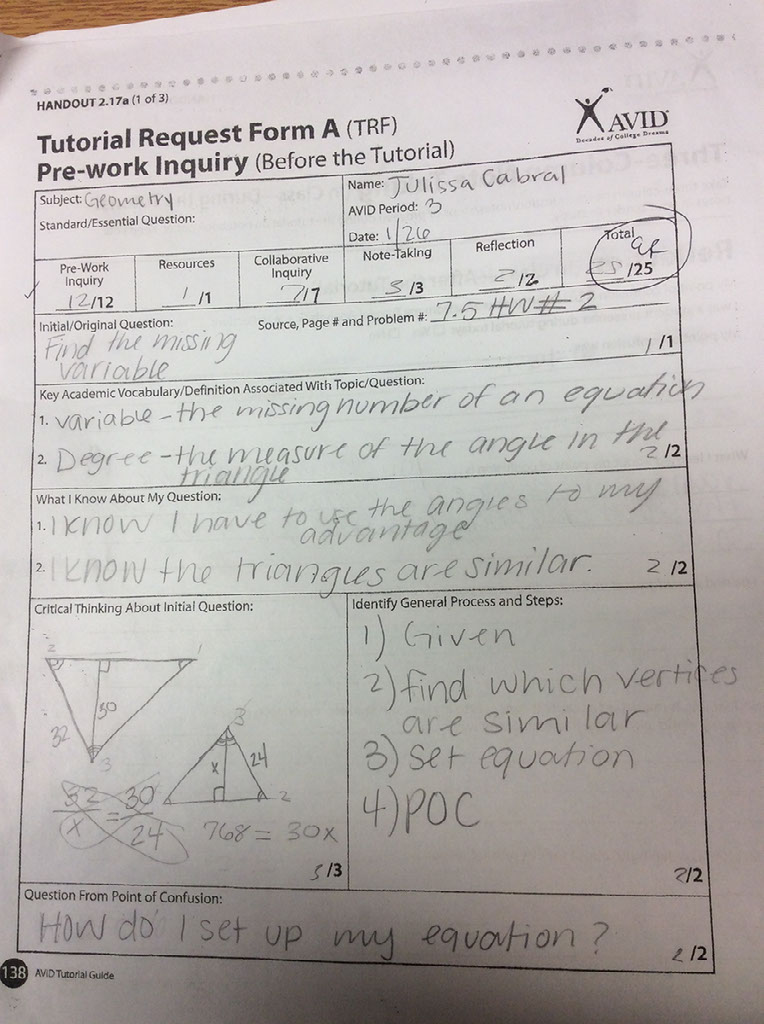
Before tutorials on Tuesday and Thursday, students complete the front side of the Tutorial Request Form ( also known as a TRF) which has a difficult question from one of their homework sheets, Cornell notes, class work, quizzes, or tests. The TRF is filled out with answers to questions that help the student break down the problem. They write all their steps up until their point of confusion (also know as their POC)
Collecting Tutorial Sheets

As students enter the classroom, an AVID Tutor collects the Tutorial Request Forms and sorts them out into subjects and groups. TRFs are the “golden tickets” required to enter class and are required every Tuesday and Thursday
Scoring Tutorial Sheets
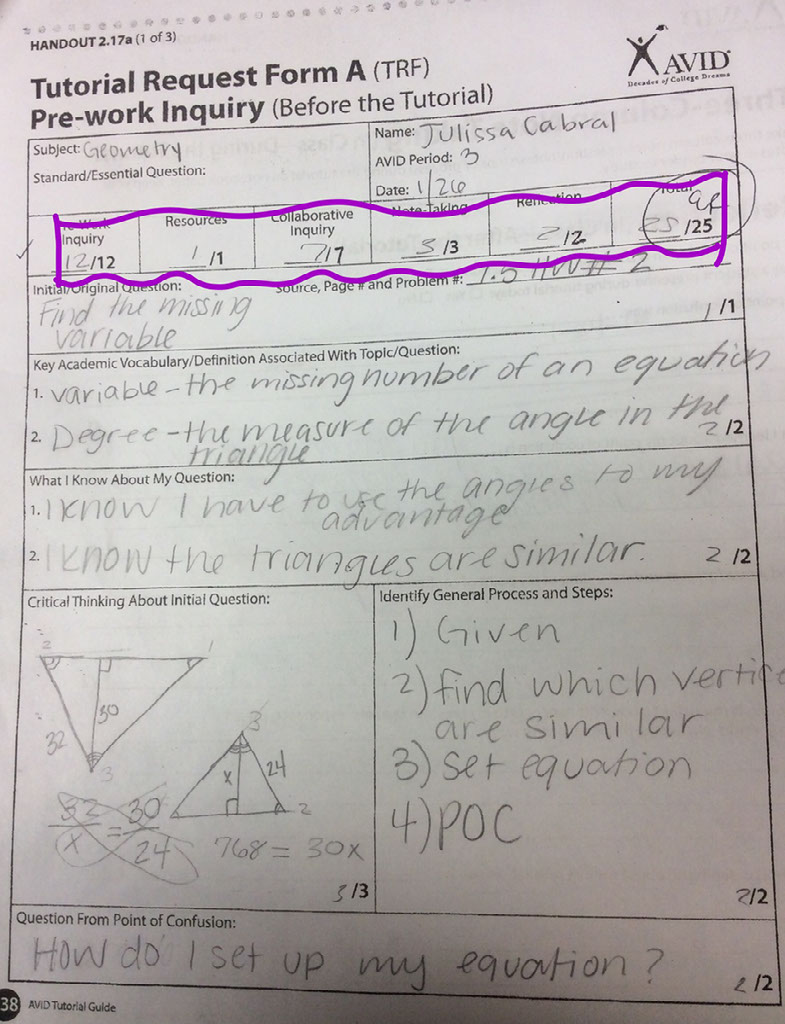
AVID Tutors score side 1 of the TRFs as soon as they get turned in. If the TRF is turned in late, the tutor will count off points of total score.
Getting into Tutorial Groups
The Tutors beforehand have separated the TRF's into different subjects and start calling out the groups. The desks are aligned to wrap around a whiteboard and names are assigned to those groups.
Whiteboard Set Up

The whiteboard is split up into three sections, POC, Notes, and Steps
How To Present a Question

1. The student writes their POC and problem along with any notes they have
2. Present the POC and give a quick summary of what they already know.
3. Explain how they tried to solve the problem up until they got confused.
4. Wrap up the summary and prepare for questions.
Questions to Ask During Tutorials
"Do you have notes?" "Is there more than one way to solve the problem?" "What if you tried to ___?" "Could you find a similar problem in the book?" "Can you illustrate what you've already done?"
Taking Notes
During tutorials students are to take three column notes. It is set up like the board with the sections of the POC, the Notes, and the Steps.
Reflections
Reflections are completed during the last few minutes after tutorials are finished and everyone has presented. Reflections are done to summarize how you solved the problem and determine what steps you took.
Why Reflect?
It is proven that students who reflect over their problems preform better than those who do not. Therefore, after tutorials AVID students fill out reflection forms to better themselves in their academic classes.