DukeEngage What comes after the summer of service? Findings on the Impact of DukeEngage (June 2016)

The DukeEngage experience is immersive, collaborative and experiential. Through community-driven service, in which participants address partner-identified needs, students develop a better sense of themselves and their academic and professional goals. This model of learning, in which Duke faculty and community partners serve collaboratively as co-educators, produces a number of positive impacts on participating students.
This is not extracurricular. This is not a hobby. This is not mission work. This is education." — Richard H. Brodhead, President, Duke University
Impacts on Participating Students
From our 2012 six-month follow-up student reflection survey, we found that:
- More than 70% of participants considered DukeEngage to be a personal growth experience;
- Students report that they are better leaders after DukeEngage: 60% were more confident, 55% felt more able to lead in challenging conditions and 50% were more outspoken;
- Participants developed more specific foci within their major, minor or other course of study;
- Teamwork skills were enhanced: 70% of participants found they could be more collaborative and were better able to work with diverse teams; 60% were more adaptable to others’ work paces and styles;
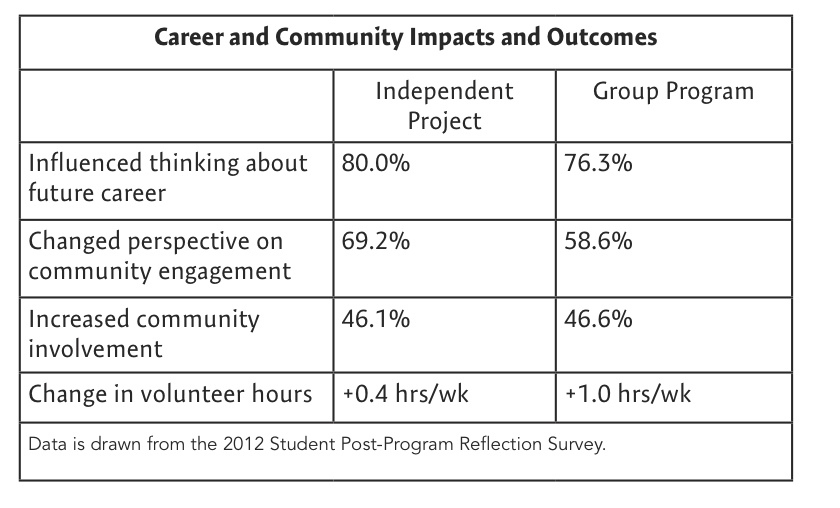
- The experience encouraged ongoing service: on average, participants increased civic involvement by an hour a week in the semesters following DukeEngage; and
- Students’ experiences shaped their professional goals: nearly 80% reported that DukeEngage had influenced their career plans.
Impacts on Alumni
Reflecting back on their DukeEngage experience, alumni report that DukeEngage is a catalyst, unifying course of study and co-curricular activity.

For example, one Uganda participant linked his DukeEngage program with FOCUS and his Pratt capstone:
"My DukeEngage program provided firsthand experiences with social enterprise work, field-based engineering, and sustainable development. I had just finished my first year at Duke and participated in the Engineering Frontiers FOCUS program, which had classes explicitly named after a few of these topics, but being on the ground and actually carrying out the work made this learning much, much more engaging and meaningful. Over the next three years I participated in follow-up classes, at least one of which was sponsored by DukeEngage, and sought to deepen my experiences. I returned to Uganda after my junior year as an NAE Grand Challenges Scholar and applied many of the basic civic engagement principles I had learned at DukeEngage. After I turned in my senior thesis, I remember that at first it all felt serendipitous: how my experiences all fit together. But I realize now that DukeEngage touched off a series of connections and experiences to build on. It was a key life experience." — Eric, Uganda Alum, 2008
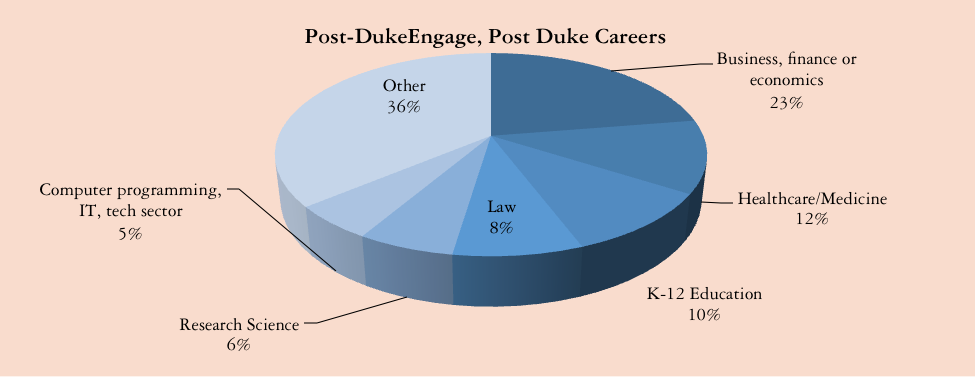
In addition to these short-term impacts, we seek to understand the longer-term results of a DukeEngage experience for students. In the fall of 2013, we reached out to more than 1,000 alumni to learn more. From the responses of 400 of these young adults who had participated in DukeEngage dating back to the inaugural 2007 summer, we learned that DukeEngage impacts persist beyond the summer and beyond Duke graduation. Data from our alumni survey suggest that DukeEngage alums are working in 17 sectors, public and private, and that our alumni are more likely than their Duke peers to pursue careers in three different fields: 22% work in business, finance or economics, with anecdotal evidence suggesting participants drawn to innovative or entrepreneurial careers; 12% work in health care, with a significant share working in public health; and 10% working in K-12 education, including teaching, consulting and policy work. Moreover, 35% of alumni feel DukeEngage had a great influence on their career choice, with 32% reporting strong connections between the work they do now and their DukeEngage program.

90% of students in DukeEngage group programs report gaining insights about themselves; 83% gained a more informed world perspective.
One alumna of the SEC-partnership program in Guatemala reported that even though her career has taken her away from the nonprofit sector, DukeEngage provided a provided a positive “disruption” to her academic and professional trajectory, writing:
I realized the benefit of DukeEngage years after the experience. The summer gave me a much more global perspective that I'm sure benefitted me academically and professionally. Looking back, I think the greatest thing I gained from my time in Guatemala was a firsthand awareness of the problems third world countries face and the development of empathy for those populations. It is easy to live your life coming from upper middle class suburbs, spend four years in an insular bubble in Durham, and then go off to a high-paying job in NYC, DC, Atlanta, Chicago, etc. The path followed by many Duke students puts you at a greater distance from the world's troubles with each step. DukeEngage disrupts that trajectory. —Julia, Guatemala SEC Alumna, 2009
Additionally, more than 80% of alumni report that DukeEngage had at least some impact on their current volunteer work, philanthropy or civic engagement. Of the 282 individuals who considered themselves active volunteers, 85% reported that their volunteer work was connected, thematically, organizationally or otherwise, to their DukeEngage service.
Our alumni share that even when the impact of DukeEngage is less central to their post-graduate life, the opportunities afforded by the program – particularly learning without many of the costs typically associated with internships or study away – can profoundly change the overall Duke experience for the better. One alumna wrote of the access DukeEngage allowed her:
I give DukeEngage a lot of credit for providing me an opportunity to work in an internship that I otherwise would have been unable to do. As a lower income student at Duke… I didn't have the luxury to take an unpaid internship. The opportunity and funding that DukeEngage provided was instrumental in giving me an experience that greatly impacted my career path. While I have not used that education and experience as directly in my career path, it has certainly helped frame my approach to business and my professional career. I'm honestly not sure how DukeEngage could change, but I would certainly encourage that it remain as it was for me — a place where [someone from the] lower middle class can have a fully funded educational opportunity. — Sara, Durham ELI Alumna, 2008

Key Student Impact Comparisons: Group Programs vs. Independent Projects
Finally, in our review of alumni survey responses, we found that for one subset of DukeEngage participants, those entrepreneurial students who designed their own independent projects, long-term impacts were particularly pronounced in several key student development areas, notably students’ understandings of themselves and their privilege as well as their knowledge and awareness of world issues. Those who completed independent project participants are more likely to report strong thematic and service connections between their DukeEngage experience and their current work or study, the result of these students creating an experience more closely aligned with long-term goals.

92% of independent project students report being more aware of global issues
80% of independent project students say DukeEngage influenced their thinking about their future careers

Program Spotlight: DukeEngage-Detroit

Program themes: Social innovation & Community development
Founded: 2014
Leadership: Matt Nash, Managing Director for Social Entrepreneurship, Duke Innovation & Social Entrepreneurship Initiative
Signature projects:
- Working with Next Energy, a nonprofit focused on the development and growth of energy and transportation companies, technologies, and industries, two students developed live-updating graphs that tracked the organizations progress toward investing $25 million in Detroit.
- Working with Detroit Future City, two students began the development of a Green Calculator that would assess the value of a certain parcel of land and what the benefits would be in restoring the land, working from previous calculator examples and values the students took by researching Detroit properties.
Key student impacts:*
- Improved ability to advocate for one’s own ideas and listen to the ideas of others
- Gained unique perspective on current societal issues and challenges
- More integrated into the academic life of campus (including presentations, research opportunities, extracurricular clubs, etc.)
Program Spotlight: DukeEngage-New York City

Program themes: Women’s empowerment & Social justice
Founded: 2009
Leadership: Ada Gregory, Executive Director, Office of Interdisciplinary Program Management
Signature projects:
- Working with the Brooklyn Movement Center, a student helped organize and pilot weekly bike patrols that would attempt to prevent or intercede in harassment and would document incidences to better understand harassment patterns.
- Working with Legal Momentum, a nonprofit focused women’s economic stability and personal security through changes to the law and policy, a student developed a research project and fact sheets on adolescent dating violence that informed the organization’s advocacy work.
Key student impacts:*
- Increased confidence and better able to see oneself as a leader or manager of a group
- Encouraged reflection on career goals and encouraged students to consider different careers
- More politically involved or aware of political issues
- Better understanding of personal identity
Program Spotlight: DukeEngage-Togo

Program themes: Community Development & Youth Migration
Founded: Group Program 2013; Independent Projects 2008
Leadership: Charles Piot, Chair and Professor of Cultural Anthropology and African and African American Studies
Signature Projects:
Working with the communities of Farendé and Dwudé to reduce poverty and youth migration out of the community, students have:
- Helped build and sustain a solar-powered internet café that connects the community to opportunities and resources, including computer literacy instruction.
- Developed Microfinance des Jeunes de Farendé, a lending program that provides young adults loans to support the development of their local businesses.
Participating DukeEngage students have turned their experiences into research that informs the field of student-led international development, publishing with Dr. Piot the book Doing Development in West Africa (DukePress, 2016).

Key student impacts:*
Encouraged students to change their academic choices, including developing new independent studies and participating in service-learning courses
Developed students’ leadership abilities, particularly the ability to lead confidently and effectively in diverse teams
A Continuing Focus on Impact and Assessment
Over the next two academic years, we will expand our understanding of DukeEngage’s long-term impacts with new data from the Duke Alumni Survey and a second DukeEngage alumni survey project. As we work to update DukeEngage’s impact data, reports and additional information can be found on the DukeEngage website:
