

Trade with India was essential to the British Empire. People wanted stuff: tea, cotton, and opium were a few of the goods that India produced.

The British East India Company was the first to develop trade and colonize India. It had been given permission to trade with India by the Mughal Empire in 1617. However, some opposed the generous trade deals given to the British, and the armies of the East India Company defeated weak Indian forces in 1757. Robert Clive, which had led the British forces, was appointed governor of Begal. Thus, the first political foothold in India began.
By the 1850's, the East India Co. owned almost the whole subcontinent. Things came to a head in 1857 with the Sepoy Rebellion (or War for Independence, if you were from India).

Guns and steel were reasons that Britain was able to take over India. They had superior weapons and resources, which the Indians could not match. The new rule under Britain was called the British Raj, which ruled until 1947.


Effects: Famine
British economic policies contributed to famine. There were 15 major famines in India between 1769 and 1944. Uneven rainfall and an overuse of export crops, which the British economy relied upon, reduced the amount of food that could have been grown for Indians to survive. Additionally, grains were exported for profit and not used domestically for food.
The Great Famine of 1876–78, also known as the Great Famine of 1876–78, which affected the southern portion of India, killed 10.3 million people.
Effect: Deforestation
Europe's population was experiencing rapid growth during the 1700s and 1800s. This caused a great demand for food and raw materials. Thus,cultivation of land increased during colonization of India. The British encouraged the production of commercial crops like jute, sugar, wheat and cotton.


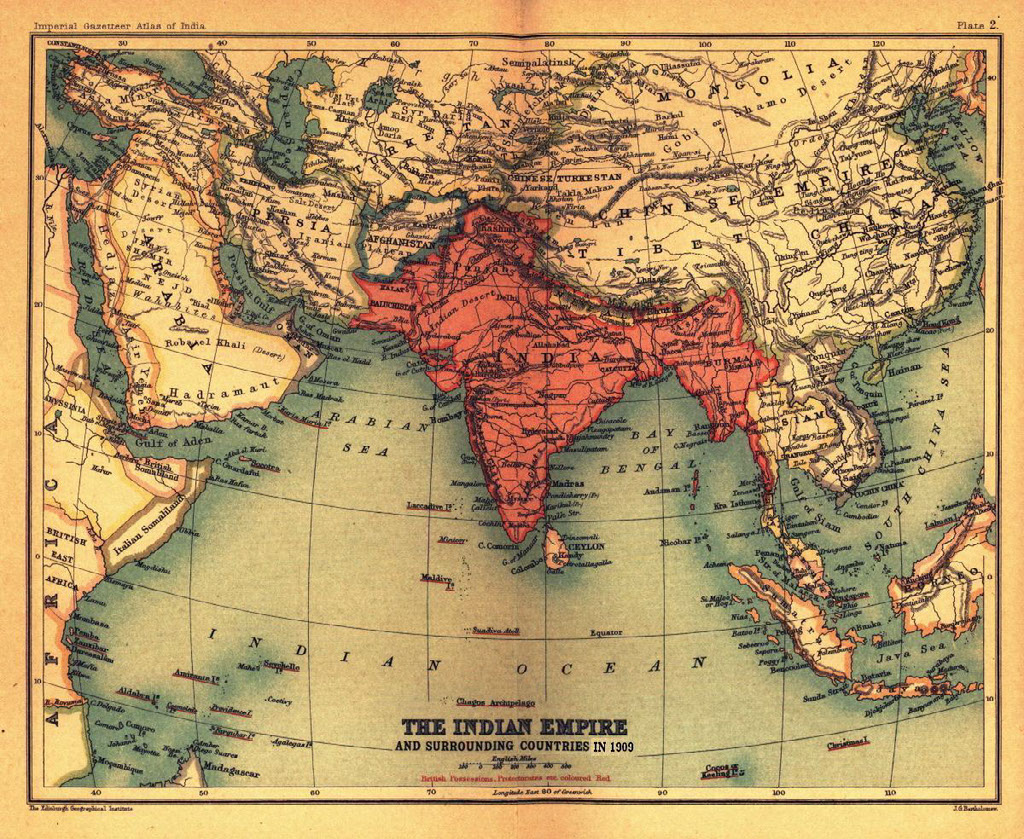
Map of Colonized India: By Scanned and reduced from personal copy by Fowler&fowler«Talk» 21:35, 18 March 2008 (UTC), PD-US, https://en.wikipedia.org/w/index.php?curid=16380308
Engraving from The Graphic, October 1877, showing the plightSeptember 2011 (UTC), Public Domain, https://commons.wikimedia.org/w/index.php?curid=17935134 of animals as well as humans in Bellary district, Madras Presidency, British India during the Great Famine of 1876–78. By Horace Harral (active 1844–1891) - For H. Harral, see National Portrait GalleryTransferred from en.wikipedia by SreeBot. Scanned and uploaded by Fowler&fowler«Talk» 20:52, 7
Children rescued by Arya Samaj in 1908 Indian famine By Internet Archive Book Images - Image from page 264 of "The Arya samaj; an account of its origin, doctrines, and activities, with a biographical sketch of the founder" (1915), No restrictions, https://commons.wikimedia.org/w/index.php?curid=39393047
WSU Digital Library https://history105.libraries.wsu.edu/spring2015/2015/01/20/lingering-effects-of-western-european-colonization-on-modern-day-outsourced-labor/
Wikipedia https://en.wikipedia.org/wiki/Colonial_India
Credits:
Created with images by An Ode To Aphrodite.. - "River of Blood" • Unsplash - "person woman india" • whale05 - "Justice? The Indian Rebellion of 1857" • wellcome images - "Albumen photograph of famine in Mysore, India, 1876" • Unsplash - "deforestation deforest lumber" • Fæ - "Motihari station, India, ca. 1906 (IMP-CSCNWW33-OS14-6)"