Victorian Theater The Artistic Revolution
One of the most important and extreme ages of revolutionary theater was during the Victorian Era in Great Britain. During this prominent period, a series of rebellions lead to a unified revolution that modified the world of theater and cinema forever.
In the early 18th century, there were only two main theaters in the entire nation, Covent Garden and Drury Lane, that solely presented Shakespeare’s fine works. However, as the Industrial Revolution brought immigration to England, there was a high demand for entertainment, especially for the working class. Both Covent Garden and Drury Lane were packed to the brim with high society, but ticket prices were drastically above budget for the less fortunate. If they did get in, they were forced to view from a far away room where they couldn’t hear the actors. To account for the growing working class, humbler and less expensive theaters started emerging all over the country. However, the big theaters were government-protected by the Licensing Act of 1737, which prevented the smaller ones to show the same plays. To avoid getting sued, these lower class playhouses had to get creative [2].
They started putting on multiple shows which involved a concoction of folk tales, comedy, and musical interludes called pantomime. Shortly after, in the late 18th century, another form of theater arose called melodrama, which featured tragic scenes filled with histrionic performances and suspenseful music [3]. Neither forms of entertainment were considered ‘plays’, so neither the actors nor the facilities could be sued. These exciting new theatrical inventions as well as low prices brought thousands of British citizens from all classes to the non-patented shows. After the “patent theaters” saw the popularity of these works, they surrendered to the trend and began to diversify their showings as well [2].

As time continued, Victorian theater evolved further and further. In 1809 there was a series of dramatic protests against the high prices of the Covent Garden. Everyday for a week, actors appeared in the audience wearing scandalous costumes and shouted so loud that a showing of Macbeth had to be cancelled. Once he had enough of this chaos, the manager, John Philip Kemble, apologized and lowered the prices [2]. Soon after, the Licensing Act of 1737 was repealed by the Theaters Act of 1843 due to its impracticality. Then, it became socially acceptable for women to play instruments and perform on public stages, even as male characters [3]. In his historical book Victorian Theater; The Theater in its Time, Russell Jackson calls this era’s theater an “entertainment industry of an urban industrial society” [7].
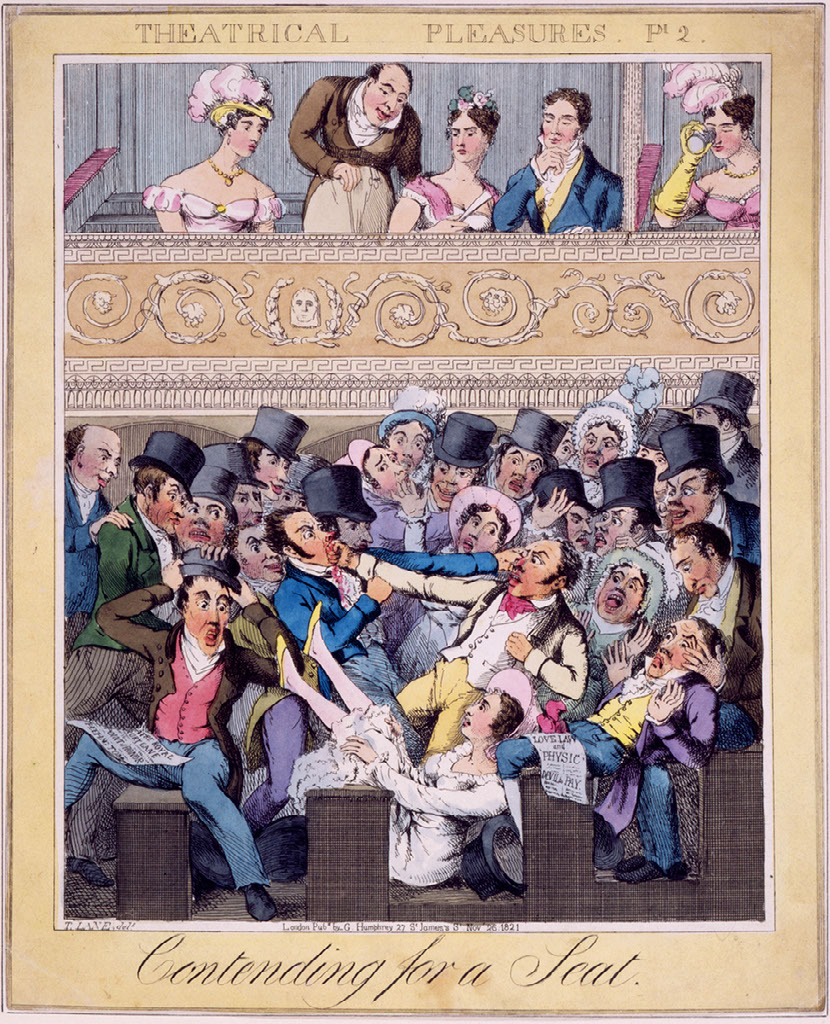
There were other types of theater that were developed during this period. One of them was pictorial drama, which targeted a middle-class audience due to its historical accuracy and articulate language [2]. Another popular form of performance art was opera. In England, the most notable form of opera was Italian due to its exotic nature and beautiful singers like Madame Catalani [1]. Sometimes theaters also showed circus-like acrobatics that excited and satisfied many show-goers. In the mid 19th century, works by acclaimed novelists such as Charles Dickens were adapted into full-length plays [5]. By the tail end of the Victorian Era, playwrights and actors were paid more and advancement in light and sound design allowed them to truly express their intellectualism on stage [4].

Overall, the Victorian Era marked a time of increasing development and evolution of theater, and the result was a legendary artistic period of joy. Charles Dickens, summarized the romantic beauty of the stage in his 1850 novel Household Words: “The gallery was of enormous dimensions and overflowing with occupants. It required no close observation of the attentive faces, rising one above another, to the very door in the roof, and squeezed and jammed in, regardless of all discomforts, even there, to impress a stranger with a sense of its being highly desirable to lose no possible chance of effecting any mental improvement in that great audience” [6]. Although this accurately represents the visual grandiosity of this facility, there was a much more meaningful beauty in this change: the unification that it brought among England. While the working class was usually disrespected and ignored, theaters were places without discrimination or hatred where an audience could be collectively entranced and engaged by a show thanks to the brilliant revolutionary artists that were involved in this change.
In-Text References
[6] Dickens, Charles. Household Words. N.p.: n.p., n.d. Print.
[7] Jackson, Russell. Victorian Theatre; The Theatre in Its Time. New York: A & C Black Publishers, 1989.