Ecosystem in danger: The Great Barrier Reef BY: Ej berg
The Great Barrier Reef is of interest to me because it is an great part of research in the field of marine biology and after visiting it last year, has truly inspired me to teach others about its current threats.

During the Mesozoic era, many species of coral used to exist, however, multiple species of coral disappeared at the beginning of the Cenozoic era, however, new coral reproduces and keeps growing on top of old coral. Because of this process, over about 20 million years, the Great Barrier Reef has turned into the natural wonder that it is today.

In addition to the species above, it is also home to 30 marine whale and dolphin species, including the Indo-Pacific Humpback Whale. Also many Duogongs live here. It's also the home to 100 jellyfish species, It's reptilian species include all seven species of sea turtle which include the
- Olive Ridley
- Hawksbill
- Leatherback
- Green
- Loggerhead
- Kemp 's Ridley
- Flatback
As well as saltwater crocodiles. It is also home to 215 species of birds and 15 species of sea grass.

As you can tell from the diagram above, the biodiversity within the Great Barrier Reef is quite high due to the fact that coral reef in general happen to be the homes of thousands of organisms.
Specialists
Specialists in the Great Barrier Reef include various species of sturgeon fish, as well as various species of coral. The effects of human activity have been shown in the reefs as coral bleaching, the process in which coral expels the algae and their pigmentation as the result of changes in the environment.
Generalists
Generalists in the Great Barrier Reef include many species of sharks, whales, dolphins which happen to all be very migratory species as well.
Species Diversity vs. Species Richness
As displayed above, the Great Barrier Reef is home to thousands of living things, making its species diversity quite high. Also because there is a large abundance of most of these animals, it's species richness is also quite high. However in recent years due to human activity, many of the Great Barrier Reef's species have begun to become threatened or endangered, effecting the species richness of that ecosystem.
Interspecific Competition
Resource Partitioning
An excellent example of resource partitioning occurs within two species of damsel fish. According to the research of multiple scientists at James Cook University, the damselfishes D. auruanus and D. melanurus typically feed on corals. When the two species coexist in the same areas, D. melanurus would switch from feeding on corals to eating smaller prey like algae.
K-Selected and R- Selected species
- K-Selected Species: Many K-Selected species happen to live within the great barrier reef. Many of these happen to be large mammals. One of these would be the Humpback Whale. Usually Humpback Whales one have one calf and care for the calf for multiple years after it is born.
- R-Selected Species: Many R-Selected species also happen to live within the reef as well. Many of these happen to be fish and reptiles. One of these would be Green Sea Turtle. This turtle lays hundreds of legs and once those eggs hatch they have to fend for themselves in order to survive. Sadly a handful of the hundreds of eggs laid actually survive to reach adulthood.
Primary and Secondary Succession
- Primary succesion occurs in a very unique way on the great barrier reef. Because of the way coral builds on top of each other, they can form islands. Vegetation actually grows on top of some of the new islands that form. Mangroves can grow as the result of the formation of these islands to allow primary succession to occur and continue.
- Queensland, Australia is known to have some quite extreme weather, among this weather, tropical storms and cyclones are included. As the result of this, many coral reefs and sea grasses are destroyed from time to time. However, after a period of time, the coral can grow back to its previous state.
Biome: Coral Reef
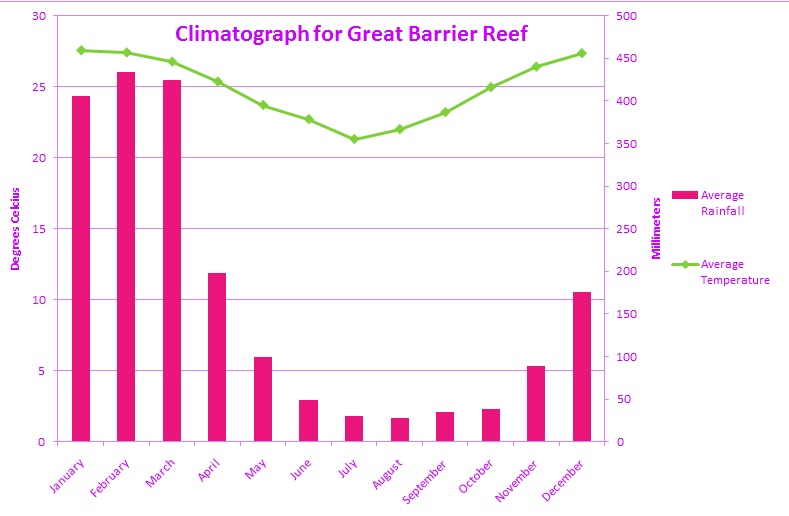
The Great Barrier Reef is wet all year round (Pun intended). However it does receive plenty of rain as well during the summer months January, February, and the beginning of March. This biome, although a part of the ocean is not considered to be a part of the ocean biome. It is typically found in tropical areas in shallow waters.
Freshwater/Saltwater Systems
This biome happens to be located within the Pacific ocean. Oceans as we all know, happen to be completely made up of salt water, with the exception of parts that have frozen. However the Great Barrier Reef is not located where water freezes. As the result of this, the reef is completely located in a salt water environment.
Geological Structures
The Great Barrier Reef itself is a geological structure. It happens to be one of the 7 Natural Wonders of the world. The series of coral reef stretches for hundreds of miles.
The Crown of Thorns Starfish

This venomous species of starfish as mentioned earlier hunts and eats corals. These starfish have been infamous for devouring large amounts of coral in large outbreaks. They are the second largest threat to the great barrier reef. In fact, this species of starfish alone is responsible for 42% of the loss of coral within the great barrier reef.

Organizations Trying to Help
- Great Barrier Reef Foundation
- National Oceanic and Atmospheric Association
- United Nations Educational Scientific and Cultural Organization
How We Can Help
- Many of the organizations above accept donations
- We can help raise awareness
- We can travel there and help with the removal of crown of thorns sea stars
Bibliography
- www.livescience.com
- www.coral.aims.gov.au
- www.qm.qld.gov.au
- www.dpi.nsw.gov.au
- www.publish.csiro.au
- www.gbrmpa.gov.au
- www.eoearth.org