Classifications of Vocabulary Learning Strategies
The Importance of using vocabulary learning strategies
“Learners need to not only know about strategies and understand what they involve, but they need to become very comfortable with their use. Until they reach a satisfactory level of comfort with a strategy it is unlikely that they will truly experience its effectiveness and find it as easy to use as their default strategies.”
Moir and Nation, “Vocabulary and good language learners” in Lessons from Good Language Learners, p. 170, Cambridge University Press, 2008
Conscious steps in learning new words
Learn new words (exposure/receptivity)
Practice newly learned words (cognitive activities: exposure and receptivity)
Store and retrieve newly learned words (mental activities: full receptivity)
Use newly learned words (productive use)
COHEN'S CLASSIFICATION (1990)
1- Strategies for Remembering Words
2 Vocabulary Learning Strategies (Word meaning)
3 Strategies for Practicing Words (Note: the steps suggest passive vocabulary building/receptive)
Strategies for Remembering Words
Linking the word to the sound of a word in NL/TL/other L
Attending to the meaning of a part or several parts of the word
Noting the structure of part or all of the word
Placing the word in the topic group to which it belongs
Visualizing the word in isolation or in a written context
Linking the word to the situation in which it happened
Creating a mental image of the word
Associating some physical sensation with the word
Associating the word with a keyword
Vocabulary Learning Strategies (Word Meaning)
Analyzing Words
Learning Cognates
Using a Dictionary
Strategies for Practicing Words
Using Flashcards
Grouping
Understanding vocabulary
as an accumulative study (explain what a word means and follow up with planned repetition of using the word in different contexts)
BROWN & PAYNE'S CLASSIFICATIO (1994 [Five Essential Steps]

Step 1: Encountering new words (Strategies to encounter new words to learn)
•Watching TV
•Listening to radio
•Reading newspapers and magazines
•Interacting with native speakers
•Studying wordlists and textbooks
Step 2: Getting the word form (Strategies to get clear visual image and/or auditory input of the new word forms)
•Associating new words with NL words that sound similar
•Writing the sounds of new words with NL sound symbols
•Associating new words with words from another language with similar sounds
•Associating a new word with a TL known word that sounds similar
•Seeing a word that looks like another known word
Step 3: Getting the word meaning
•Asking native speakers
•Forming mental pictures of word meaning
•Using dictionary
•Guessing from context
Step 4: Consolidating word form and meaning in memory
•Grouping words
•Using key words
•Structured reviewing
•Mnemonic associations (e.g., associating a TL word with an L1 word that has similar sound, associating a new word with a mental picture of the word, etc.)
Step 5: Using the word
Using newly learned
lexical items in contexts
If the goal is receptive, Step 5 is not needed
SCHMITT's CLASSIFICATION (1997)
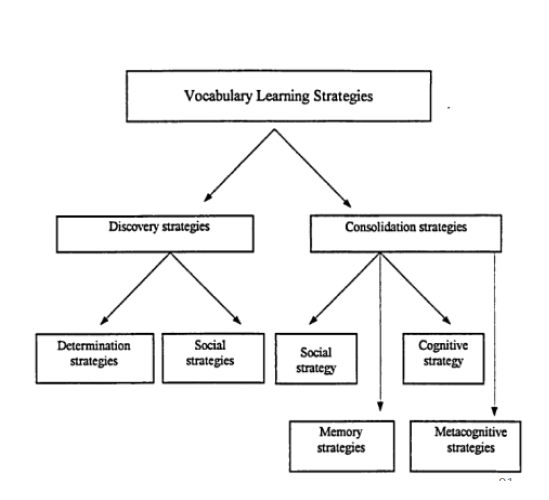


Other commonly used vocabulary learning strategies Sources: Nation (1990), Oxford (1990), Gu & Johnson (1996), and Beaton, Grunberg and Ellis (1995)
•Using clusters or webs
•Mnemonics or memory tricks
•Visual mnemonics, physical mnemonics
•Grouping
•Elaborating
•The narrative chain
•Semantic mapping
•Personalization
•Real-life practice
•Association
•Use of a dictionary
•Key word technique (linking sound & images)
Some common vocabulary strategies used by students
•Taking notes when watching videos
•Making words list (testing oneself)
•Writing down/repeating words repeatedly
•Using new words in sentences
•Imagining the word’s meaning
•Reading from a dictionary
•Reviewing before tests
Matrix of Vocabulary Learning Strategies (Compiled and adapted by SLC, See ILS Course Pack, Page 78)
Metacognitive strategy: A general learning strategy that includes organizing, planning, managing, monitoring, and evaluating your learning
Task-based learning strategies: Focus on how students can use their own resources to learn most effectively (Use what you know, use your imagination, use your organizational skills, and use a variety of resources.